A foil star costs a fraction of a cent. It has outlasted every curriculum fad of the last fifty years.
Every elementary guide knows the sticker chart. A child finishes their work, walks up to the desk, and a small star gets pressed onto a square with their name on it.
It is worth asking why something that cheap works at all, because the answer says a lot about what a daily plan should do.
A star is not a reward. It is a receipt.
The star is not really payment for the work. A seven-year-old does not value foil. What the star does is make an invisible thing visible: I did the thing I said I would do today, and somebody noticed.
That is three jobs in one sticker. It closes the loop, because work that disappears into a folder can feel like it never happened. It arrives immediately, while the effort is still warm, rather than at report-card time. And it accumulates where the child can see it. One star is nothing. A row of fourteen can become a story a child tells about themselves—and children tend to protect a story like that once they have one.
The daily part does the heavy lifting
Here is the part that is easy to miss: the star works because it is attached to a day rather than a semester.
A goal a child can finish today is a goal they can picture. “Get better at reading” is weather. “Read a book you enjoy, do three math lessons, finish your handwriting page” is a list, and a list has an end.
Daily goals can also fail safely. A child who has a difficult Tuesday still gets a clean Wednesday. Compare that with a long unit, where falling behind in week one can mean spending week four knowing you are behind. Short cycles keep the verdict small.
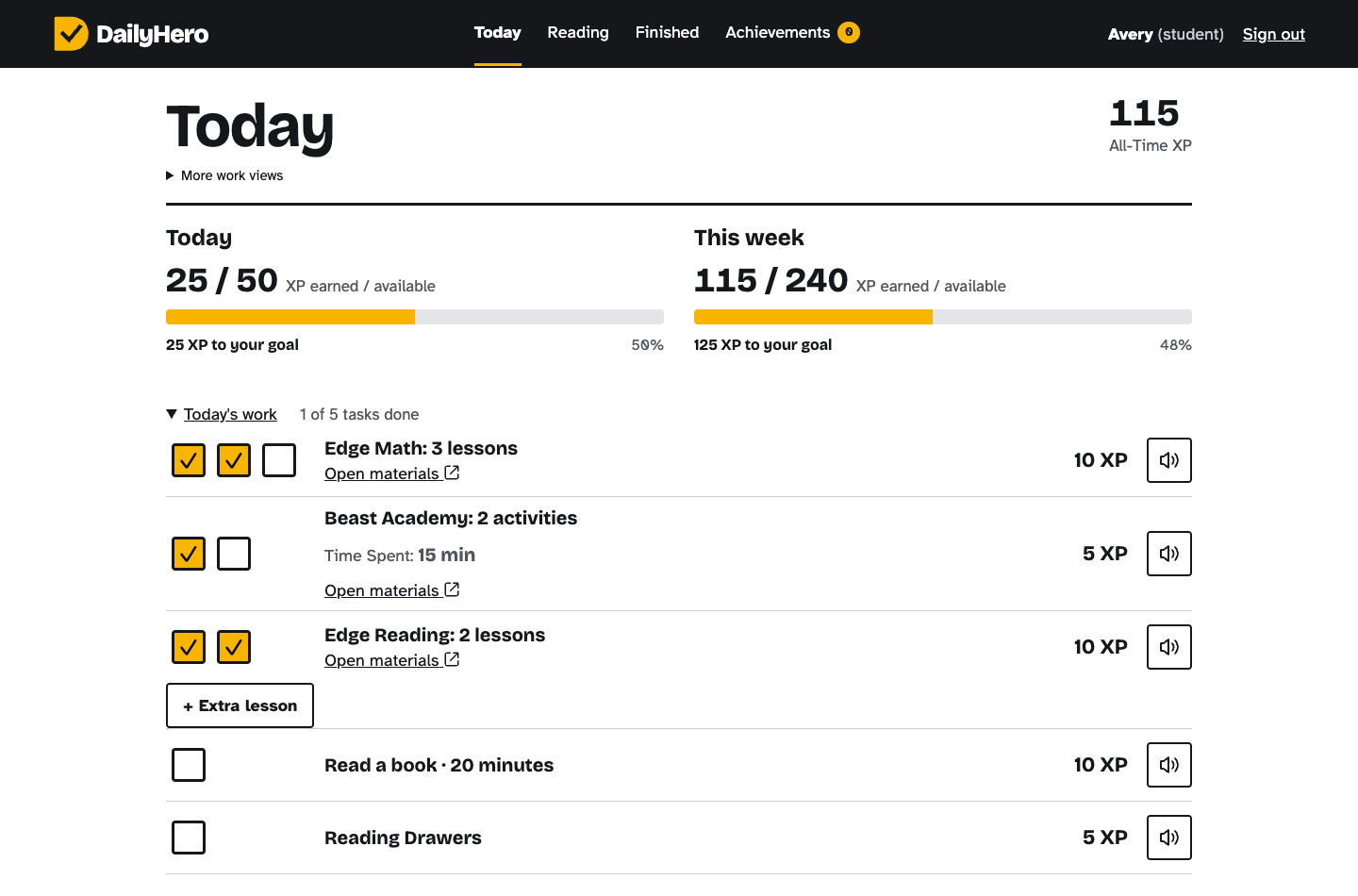
A daily list asks something of the adults, too. When a guide has to decide what today’s work actually is, a vague plan has nowhere to hide.
So what is XP, really?
XP is the golden star with the three jobs kept and some of the limitations dropped.
It still arrives the moment work is recorded, not overnight. It still accumulates visibly: a learner can see today’s points, the streak behind them and the achievements they have collected.
What it adds is reach. A foil star lives on a wall in one classroom. When a learner finishes a book chapter on a Saturday morning, their guide is not standing there—but the points still land, the streak still holds, and a linked family can see it. The work gets noticed in the two places that matter to a child: where they are, and at home.
It also lets the size of the star match the size of the task. In DailyHero, reading, a curriculum lesson and a one-off task each carry their own XP, set by the guide. A demanding task can be worth more than a quick one—the single piece of information a flat sticker could never carry.
Where points go wrong
Anyone who has run a sticker economy knows how this breaks, and a digital version can break the same ways faster.
FOUR WAYS POINTS LOSE THEIR MEANING
- Points for volume instead of effort. If more clicks earn more points, children will click. The protection is not clever scoring; it is that points hang off work an adult chose on purpose.
- Points that never stop. A learner who can earn unlimited credit by grinding may grind. DailyHero limits how much extra work counts in a day, so the plan stays the goal.
- Points nobody looks at. A star in a drawer stops being a star. Families need a view, not just a login.
- Points standing in for judgment. XP says a learner did their work. It does not say they understood it.
That last one deserves its own sentence. A learner can have a complete week of XP and still need a different book or a different lesson. Assessment evidence and a guide’s judgment answer that question; points never will. Software should be able to show both without pretending either one is the other.
The quiet case for daily goals
Strip away the technology and the argument is simple. Children tend to do better when they know what today asks of them, when finishing is possible, and when finishing is noticed.
The star was always the cheapest part of that. The expensive part—deciding what today’s work should be, and paying attention when it is done—belongs to the guide, and always will. XP mainly makes sure the noticing happens every time: including on the Saturdays, and including for the parent who was not in the room.